

The value of rarity
Understand your upside before buying gold
The Deficit Triangle
The number of zeros on formal statistics sometimes disguises their real meaning.
The US government currently borrows $5,000 a year on behalf of each US
family, which it dares
not tax for electoral reasons.
This is the
source of the budget deficit. That uncollected money remains in the
hands of the
family, which currently
prefers buying foreign goods and
spends $5,000 on them, producing the trade deficit. The
foreign
supplier sends the $5,000
back to the US by buying government bonds and
American businesses. This money from abroad is the
source of the
fine-sounding US capital inflow.

Give or take $1,000 this same $5,000 deficit triangle is completed for
each of about 100 million
US households every year, and
that is why
there is a $500 billion budget deficit, and similar trade deficit and
US capital
inflow. It is tempting to
assume that this is the way it has
always been and that somehow it must be stable, but that is
wrong. This
is a wholly new
way of arranging things.
Source of US economic growth
The last four-year administration ended having increased the average US
family's gross future
tax debt by about $19,000. The
family's total
accumulated uncollected tax - i.e. its share of the country's public
debt -
grew by that $19,000 to about
$74,000, three quarters of which
has been built up since 1985. The demand which has sustained
growth for
twenty years has
arisen from this money being spent twice, once by the
family, and once by the state, and this
duplicated spending is the
only
explanation that is needed to understand the remarkable strength of the
USA's economy.
But the legacy of it was this
$74,000 tax debt for each
of just over 100 million families, which just 18 months later has
grown
to $83,000.
The downside of debt
How serious is an $83,000 tax debt? We don't know because it has never
happened before, but we
do know that in Argentina in
2001 their
sovereign public debt was about $12,000 per family, and at that level
it
triggered the capital flight which was
the direct cause of their
debt default and subsequent economic crunch. It is both
extraordinary
confidence in underlying
USA economic robustness and an apparent lack
of alternate options which appears to be preventing a
similar US
setback. But
the confidence rests on the demand strength, which itself
arises from the scale of the deficit
triangle.
What happens next?
To resolve the US public debt problem safely is very difficult. Raising
taxes to the required
level is unthinkable - both
electorally and
because it would hurt domestic spending and feed back into a
deflationary
spiral of declining output and
demand. Trade protectionism
was tried before and it triggered tit-for-tat export restrictions
and
global depression. The
only viable route out is devaluation of the
debt, which is equivalent to inflation.
Assessing how severe the coming inflation might be is also difficult,
but it is possible to get
an idea by looking at the bond
market. For
twenty five years the bond market has been growing fast, to about 40
times what
it was in the early eighties.
Through most of that time
interest rates and inflation were falling, so fixing a rate of
return
with a bond was an
attractive option for a saver. As a result while
borrowers were spending savers were diverting
their cash out of the
economy and freezing it in bond portfolios, until eventually US dollar
bond markets have grown to
contain 50 times all the
dollars in current
circulation.
This frozen money is up for redemption over the coming years so it will
turn back into cash, and
little of it can sensibly be
re-invested in
bonds with inflation threatening and rates turning up from long cycle
lows.
In any event much of it must be
returned as consumable cash to
the retiring boomer generation.
This suggests a possible cash glut in the medium term, and that
indicates inflation too.
Aggressive inflations do tend to
follow an
accumulation of official indebtedness. It would be unusual if the
current US
situation did not result in
something similar.
Fear of this should have already caused a downwards dollar correction,
but this has not happened
because the alternate
currencies have similar
problems. The Yen is afflicted by an equally difficult sovereign
debt
problem, while the Euro
looks politically unstable and can agree
neither a constitution nor an ongoing budget. Commodities
on the other
hand have
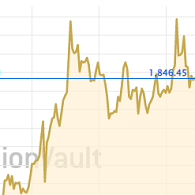
been rising in price - and gold particularly so.
Gold's rarity
Gold is famously useless in almost everything except that it cannot be made, and is reliably
difficult to find.
Even
now if all the gold ever produced on Earth were formed into a
single cube its edge would be less
than 20 metres - 2 metres
shorter
than a tennis court. Annually mined production grows that cube by about
12
centimetres a year, and more than each
year's production is used up
by jewellers such that now 75% of that cube is fabricated in an
art
form worth several times
its bullion value. Meanwhile after 15 years of
consistent selling into private demand central bank
ownership is now
down
to about 20% of the world's gold.
That 20 metre cube of gold would weigh about 140,000 tonnes and each
tonne is worth about
20,000,000 dollars. So all the gold
in the world
is currently valued at $2.8 trillion, which compares to a US public
debt of
$8.3 trillion, and an unreserved
US generational debt of $44
trillion. By contrast the US has the biggest gold reserve in the
world
which at 8,000 tonnes
is worth only $0.16 trillion, enough, were it all
sold, to stop the deficits growing for about 12
weeks.
Pricing rarity
Arising from this there are are powerful fundamental forces at work on
the gold price which
cautious savers understand
intuitively - even if
some cannot put their finger on what those forces are.
The value of anything reflects its utility at the margin,
which means it only needs a
slight shortage to create price
surges and
a slight surplus to create price slumps. The utility of gold is simply
that it is
rare, and for 5,000 years
people have used reliably rare
stuff to store value for the future. They call it money.
Almost all human societies have been able to arrange and enforce a
respectable rarity of
artificial forms of money, and so
long as savers
have been able to trust in this artificially created rarity the
marginal
utility of gold's natural rarity
stays low. Paradoxically
'rarity' is in adequate supply wherever artificial money is being
reasonably well managed, and
this makes gold's natural rarity less
valued in those times.
But what savers are now realising is that official money is not being
well managed and cannot in
future be relied upon for
rarity, and they
believe there will soon be great quantities of artificial money in
circulation. Even if the underlying
demand for rare stuff were to stay
the same then the value of the few naturally scarce things
would go up.
Much more
likely is that the underlying demand for natural rarity will
increase, and it's utility at the
margin, where a diminishing
supply of
rarity meets an increasing demand, will continue to force up the price.
This is what is happening to gold now. Arising from the scale of public
debt and the enormous
overhang of dollar bonds savers
are valuing the
unimpeachable rarity of gold higher. More and more people no longer
believe
that the artificial rarity of
dollars are offering that same
assurance of future scarcity, and until responsible fiscal and
monetary
management returns
to government the outlook for gold is likely to
remain resolutely positive.






 Email
us
Email
us