
Gold vs. DVO1 at $2000
What explains the gold price surge...?
Are GOLD PRICES and interest rates joined at the hip? asks Jim
Rickards in The Daily
Reckoning.
Based on recent market action, it would appear the answer is: yes.
A major
rally in gold is now underway.
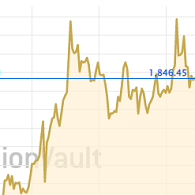
Gold moved from $1831 per ounce on Oct. 6 to $2091 per ounce on Dec. 1, a 14.1% rally in just eight
weeks and a new all-time high
price for gold.
Gold has pulled back, but that's not surprising given its
previous surge. Like every other
asset, gold can sometimes get ahead of itself and experience a pullback.
This
rally correlated almost
perfectly with the rally in the price of 10-year Treasury notes that occurred at the same time. Treasury
note yields plunged from
5.00% on Oct. 19 to 4.17%. That 83-basis point drop may seem small but it's not.
That's like an earthquake in
the world of Treasury notes. As explained below, market signs indicate that these dual rallies and close
correlations will continue
for months to come.
This dual rally gives investors a double-barreled
opportunity to make huge
gains.
As interest rates drop, the market value of Treasury notes goes up.
That's bond math 101. Yet there's
a quirk in the bond math that many investors (and even financial advisers) don't appreciate.
When interest
rates drop, bond prices go up. But the rate at which they go up relative to each drop in rates (measured
in basis points or 0.01%)
isn't constant.
The Dollar value of the capital gain for each basis-point drop
in rates rises as interest
rates hit lower levels. (The technical name for this is DVO1 for "Dollar value of one basis point". You
don't need to be expert on
this; it's just useful to understand the concept).
Put differently, if interest
rates drop from 7.0% to 6.5%,
notes have a capital gain. If rates drop from 4.0% to 3.5%, they also have a capital gain. In both
cases, the rate drop is 0.50%. But
the capital gain in the second case is materially larger than in the first case.
Right now, we're in that
zone where rates are low and going lower, which means the capital gains are getting larger. That's a big
win for investors on a
security with almost no credit risk.
What accounts for the rally in gold
prices? There are numerous factors
that affect the gold price, but certain factors dominate at certain times. Right now, the key factor is
interest rates. Rates are
going down at a rapid pace and gold is going up in a kind of synchronicity. Why?
The simplest explanation for
the correlation is that Treasury notes and gold are both high-quality assets that compete for investor
allocations. Gold does not have
a yield (although it can produce significant capital gains).
When yields on
Treasuries drop, the zero yield
on gold is relatively more attractive compared with the note yield and gold prices start to
rally.
The key
questions for investors are: Will rates continue to drop? And will gold continue to rally in sync with
falling rates?
To forecast rates, we have to look at economic fundamentals. (By the way, the Federal
Reserve is almost irrelevant for
this purpose. The Fed controls the short end of the yield curve only and has almost no impact on
longer-term rates including the
10-year Treasury note rate we are considering here.)
One conundrum of recent US
economic performance is that
GDP has remained robust while signs of a recession and possible a financial crisis keep
accumulating.
US GDP
was 2.2% in the first quarter of 2023, 2.1% in the second quarter and a strong 4.9% in the third
quarter. The best estimate for
fourth-quarter growth from the Atlanta Fed is currently 1.2%, a substantial drop from the third
quarter.
If
that Q4 figure holds, growth for the entire year of 2023 will come in around 2.5%. That's not too
shabby, and it's slightly better
than the 2.2% average annual growth from 2009-2019 in the 10-year period between the global financial
crisis and the
pandemic.
In any case, it's a far cry from a recession.
Still, a focus on full-year
growth of around 2.5% ignores the trend. When growth goes from 4.9% in the third quarter to 1.2% in the
fourth quarter, something
extreme happened. It's almost certainly the case that consumers slammed on the brakes in
October.
Recession
signs are real and growing worse. These include credit contraction, rising bad debts, increasing jobless
claims, collapsing commercial
real estate markets, contracting world trade, inverted yield curves and many other reliable technical
indicators.
How can the economy be headed into recession after such strong growth recently?
The riddle is
solved by the fact that the economy has been propped up by the consumer. That explains the growth. But
the consumer has been on a
non-sustainable path. That explains the warning signs.
The consumer came out of
the pandemic with a head of
steam provided by handouts from Trump ($1800 per adult), and Biden (also about $1400 per adult) between
April 2020 and March 2021.
That was supplemented by $900 billion of Paycheck Protection Program loans, which were forgiven one year
later.
Student loan payments were suspended from 2020-2023. The Federal Reserve held interest
rates at zero from 2020-2022. Then
the misnamed Inflation Reduction Act of August 2022 handed $1 trillion of taxpayer money to Green New
Scam businesses and other pet
projects.
With that money, Americans were able to pay down credit card balances
and build up savings. It was
a powerful double-dose of fiscal and monetary stimulus. Much of this operates with a lag so the growth
momentum carried over into
2023.
Now it's all gone. Short-term interest rates are over 5%. Mortgage rates
are over 7%. Student loan
repayments have started again. There are no more pandemic handouts. Americans' savings are depleted, and
their credit cards are tapped
out.
Now the reckoning begins. In fact, the recession may already be
here.
Interest
rates do not typically peak at the start of a recession; they peak somewhat after the recession begins.
Businesses see revenues
decline and turn to lines of credit to help with cash flow.
Only later, when
unemployment goes up and credit
losses accumulate, do banks rein in credit and then interest rates start to decline. We may already be
at that stage. The fact that
interest rates are already in sharp decline suggests the recession has already begun.
The importance of this
for investors is that interest rate declines have much further to go (probably down to the level of 2%
or lower over the next six
months), which means gold prices have further to rise (perhaps to the $2300 per ounce level or
higher).
With
both trends in place and a positive feedback loop between them, this is a once-in-a-decade opportunity
for investors.
It really doesn't get much better than that!




 Email
us
Email
us