

China's Loss, Mexico's Gain
China no longer No.1 supplier of goods to USA...
A LITTLE OVER a year ago, the world watched as China reopened its doors
after three long years of
strict pandemic lockdowns, writes Frank Holmes at US
Global Investors.
Expectations were high for a robust economic
recovery, fueled by pent-up
demand and consumer spending.
The reality has been starkly different. Despite a
bustling travel season around
China's Lunar New Year – with a record 9 billion domestic trips expected, 80 million by air – the
anticipated economic rebound has
largely failed to materialize, even as world markets have surged to record to near-record
highs.
This
downturn appears not to be just a temporary blip, but a sign of deeper structural issues within the
Chinese economy. The nation's
gross domestic product (GDP) reportedly grew 5.2% in 2023, an admirable print at first glance, but it
masks underlying challenges. A
closer look reveals a significant slowdown from the pre-pandemic era of consistent +6%
growth.
Select
industries such as electric vehicles (EVs) saw remarkable sales in China last year, but this strength
hasn't been enough to offset
serious weaknesses in other sectors, particularly real estate, which remains a major drag on the
economy.

Our decision to close the China Region Fund last year was a move predicated on recognizing early signs
of these economic challenges.
It's a decision that, in hindsight, has been vindicated.
The ongoing property
sector slump and regulatory
uncertainties have further exacerbated investor apprehension, leading to a significant outflow of $68.7
billion in foreign direct
investment (FDI) for the first time since 2018.
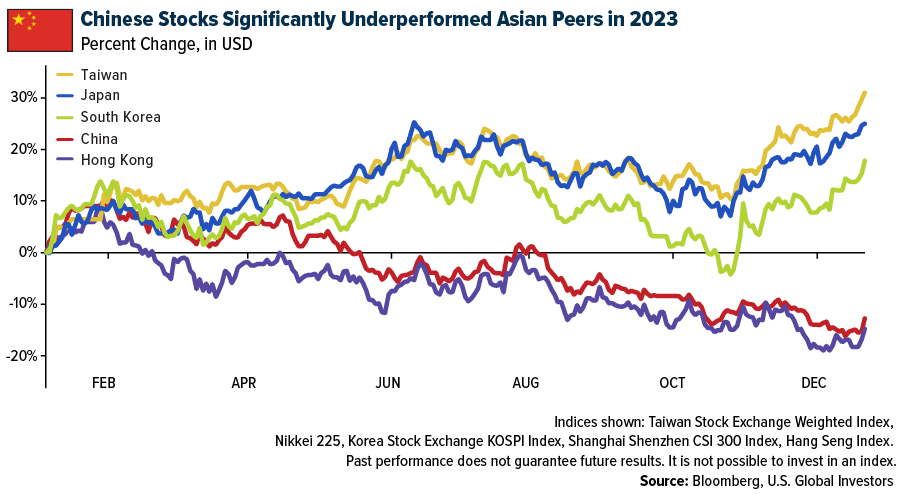
Chinese equities continue to
underperform. Both mainland
stocks and those listed in Hong Kong ended 2023 with losses, even as other Asia-Pacific markets rallied.
Remarkably, Japan's Nikkei
225 is poised to hit a new all-time high after 34 years.
This year isn't off to a great start for
Chinese stocks, either. The CSI 300 shed over 7% in January, while the Hang Seng lost over
9%.
"China seems
to be divorced from the rest of the world," Steve Sosnick, chief strategist at Interactive Brokers, told
Bloomberg. "Part of the lack
of equity response is that the global economy is doing OK without China."
Indeed, in a shift not seen in over
20 years, Mexico outpaced China last year to become the top supplier of imports to the US This change
highlights the escalating
strains between Washington and Beijing, alongside American initiatives to source more goods from closer,
more allied
nations.

Recent data
from the Commerce Department
indicates that imports from Mexico to the US increased nearly 5% from 2022 to 2023, reaching over $475
billion. Conversely, the import
value from China saw a sharp decline of 20%, falling to $427 billion.
Efforts
to stabilize the Chinese market
have so far failed to lift investor confidence. Last Tuesday, the China Securities Regulatory Commission
(CSRC) announced plans to
halt the practice of brokerages borrowing shares to lend them out and to limit the scope of what's
referred to as the securities
re-lending market, in a move aimed at reining in short-selling activities.
This
came a day after the
regulator vowed "zero tolerance" against short sellers, warning them they could "lose their shirts and
rot in jail," according to
reporting by Reuters.
These regulatory steps were introduced after the Chinese
government declared in October
2023 that it would issue 1 trillion Yuan ($140 billion) in Chinese Government Bonds (CGB) to support
local government finances and
fund infrastructure projects in areas affected by natural disasters over the past year.
The move was meant to
send a signal to global markets that China is "pro-growth" again, but as Morgan Stanley's Schuyler
Hooper writes, the strategy is seen
as "merely a repeat of China's old policy playbook, where they rely on investment to prop up 'economic'
growth, while growth in
consumption, export, property and private investment remains sluggish."
The
risk, Hooper points out, "is a
short-lived cyclical rebound amid a longer-term secular slowdown" in the Chinese market.
The Chinese
government faces a daunting task in addressing the deep-seated issues within its economy. Chaos in the
real estate market, local
government debt and deflationary pressures are significant hurdles to sustained growth. Geopolitical
tensions add another layer of
complexity.
The situation serves as a reminder of the importance of
diversification and the need to remain
agile. I believe it's more important than ever to rely on sound investment principles and a diversified
portfolio.








 Email
us
Email
us