

Back to 1909 with Trump's Tariffs
Global trade war explodes...
OUCH, says Frank Holmes at US
Global Investors.
Global markets are in freefall in response to
President Donald Trump's
universal 10% tariff on all goods being imported into the US, with as many as 60 countries facing
"reciprocal" tariffs on top of
that.
When we combine all new tariffs in 2025 so far, including the raft of
reciprocal tariffs announced last
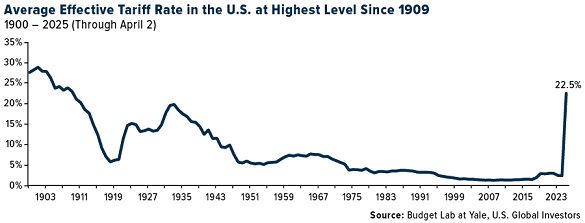
Wednesday, we're looking at an average effective rate of 22.5%, according to Yale's Budget
Lab.
That's the
highest such rate since 1909 − the same year that President Howard Taft proposed the idea of an income
tax to Congress.
As I have pointed out
before, tariffs are a type of tax paid for by domestic import-export companies, who often pass the
additional cost on to consumers.
This can turbocharge domestic inflation.
Tariffs can also lead to full-blown
trade wars, as we saw in the
federal government's previous attempts to raise revenue through the taxation of imported
goods.
The
Smoot-Hawley Tariff Act, enacted in 1930, is widely believed to have exacerbated the effects of the
Great Depression, as global trade
tanked a whopping 65%. A few decades prior, then-Representative William McKinley's tariff act triggered
retaliation from other
nations, leading to higher prices for US consumers.
(If you need to brush up on
your Smoot-Hawley history, I
recommend the famous "Anyone? Anyone?" scene in 1986's Ferris Bueller's Day Off.)
As was the case then, we're
already seeing retaliatory tariffs. China announced that it will impose a 34% duty on all goods imported
from the US. If this weren't
enough, automobile imports face a steep 25% tariff. Trump claims he "couldn't care less" if foreign
manufacturers raise prices for US
consumers, and from the looks of it, they may need to − and significantly so, in some cases.
Mitsubishi, for
instance, will need to increase the price of its vehicles by more than 20% here in the US to offset the
new levy, according to
estimates by CLSA.
The manufacturer expected to fare the best under this tariff
regime is Tesla, whose supply
chain is well-integrated in the US. More than 62% of the company's facilities are located domestically,
with approximately a quarter
of its suppliers also based in the US, according to Bloomberg data. By comparison, fewer than half of
Ford's facilities worldwide are
currently located in the US.
This could be constructive for Tesla, whose stock
has lost over half of its
value since its peak in mid-December, making it one of the worst performers of the year so far. The
carmaker's quarterly sales fell a
significant 13% in the first quarter compared to the same period last year, due mainly to political
backlash against CEO Elon
Musk.
When it comes to new home purchases, bad economic news could be good
news. Mortgage rates generally
track the yield on the 10-year Treasury, which dropped below 4% on Friday due to concerns about the
trade war. Bond yields generally
fall when prices rise.
Granted, home prices in the US are still hovering near
record highs, but current
homeowners may be able to refinance sooner than expected.
Lower yields are also
good for gold. Because it's a
non-interest-bearing asset, gold starts to look more attractive as yields fall, especially when
inflation remains historically
elevated, as it is now. The 10-year yield is nominally 4.1% right now, but when you factor in the 2.8%
headline inflation rate from
February, the real yield is closer to 1.3%.
If yields fall further or if
inflation jumps higher due to
tariffs, we may end up with negative real yields, which have historically been bullish for gold
prices.
The
yellow metal is trading down as it's swept up in the broader selloff, and I believe investors should
strongly consider buying these
dips. Gold just notched its best quarter since 1986, ending March at $3123 per Troy ounce, and there
could be further upside momentum.






 Email
us
Email
us