
A Modern History of Gold Money
...as compared to the PhD Standard....
TODAY there is a spreading awareness that our monetary situation is
rather rotten, writes Nathan
Lewis of New World Economics in this
article first posted at Forbes.
Leaving things up to central bankers, who are obviously making it up as they go along, has
not worked out very well. Most
recently, these central bankers got very aggressive in response to Covid in 2020; and the "inflation"
that has followed has not been
very surprising. People generally find monetary affairs to be extremely confusing.
But in the end it really
amounts to a choice of two alternatives: The Gold Standard, and the PhD Standard.
Today, we have the PhD
Standard. We have a bunch of eggheads with PhDs making stuff up as they go along. But this is not the
way we used to do things in the
United States.
For nearly two centuries, from 1789 to 1971, we did not have
central bankers with unrestrained
freedom to not only adjust the knobs and dials as they saw fit, but to invent new knobs and dials –
"QE", "QT", "interest on reserve
balances", "Reverse Repos" – at what seems to be an accelerating pace.
For a
long time, we did not have a
central bank at all.

Rather, the United
States used a Stable Value
system.
The value of the currency was linked to some external benchmark – gold.
This was also what all the
other major countries used too.
For a long time, the value of the Dollar was
23.22 troy grains of gold. Since
there are 480 grains in a troy oz., this worked out to 480/23.22 or $20.67 per ounce of gold. Until
1971, there was only one permanent
devaluation, by President Roosevelt, in 1933. This reduced the value of the Dollar to $35 per ounce This
continued until the floating
fiat era began in 1971.
This era was very productive for the United States. It
became the wealthiest country
in the history of the world, with the most prosperous middle class. The last decade of the gold standard
era, the 1960s, is still
considered the most prosperous of the past century. There was no big problem that needed to be solved.
Everything was working
well.
Nevertheless, due to incompetence and ambitions to engage in
macroeconomic manipulation, everything
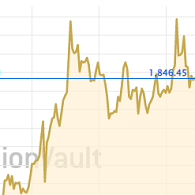
changed in 1971. Since then, compared to gold, the Dollar's value has fallen by another factor of fifty.
It now takes around $1800 to
buy an ounce of gold. During this time, the price of a barrel of oil rose from $3 in the 1960s, to about
$20 in the 1990s, to over
$100 today. At no time did any central banker say that they were in favor of inflation and declining
currency value. They all said the
opposite. It just happened anyway – just as it always does.
The Stable Value
system is still common today.
Actually, more than half of all countries worldwide have a Stable Value policy. They do not have a
floating fiat currency, and
homegrown central bankers making stuff up as they go along. They tried this in the past, and it created
problems, so they abandoned
it. Usually, they link their currencies to the USD or EUR. (The International Monetary Fund prohibits
countries from tying their
currencies to gold.)
Thus, the monetary history of the United States boils down
into two great eras: The Gold
Standard Era, and the PhD Standard Era, of floating fiat currencies managed by oh-so-very-smart people
with PhDs.
I would say that, not only has this been our experience in the US, and also mirrored around
the world, but that these are
the only two realistic options. There are a lot of fantasies out there. But, along with other "utopian"
notions like centrally-planned
communism, these don't work in real life. Humans, and their political institutions, are capable of
certain things, and not capable of
other things.
For example, there is some interest in "rules-based systems."
This business of having central
bankers just make stuff up as they go along is very unsettling, and often leads to difficulties. These
"rules based systems" include:
nominal GDP targeting, other monetarist variants, Taylor Rules (in effect, interest rate manipulation),
CPI targets, and other such
things that assistant professors like to invent whenever they think it will help them advance their
careers.
None of these have been tried in the real world. When something like this is tried, it typically blows
up in their face, just as the
"Monetarist Experiment" that Paul Volcker tried in 1979-1982 had to be quickly abandoned. All of these
are floating-fiat systems of
macroeconomic manipulation, albeit a somewhat programmatic one instead of today's seat-of-the-pants
improvisation.
Forseeably, the currency would have some kind of sickening change in value, and interest
rates would go here and there in
response. This becomes intolerable, so central bankers have to step in to fix it, and then we are back
to improvisation again. This is
exactly what happened to Volcker.
We could also ask: Even if there are rules,
will the central bank follow
the rules? What if there are political pressures for them to do something else, as often happens around
elections, or in recessions,
or whenever the stock market falls more than 20%? The Federal Reserve has something close to a rule in
the form of a concrete CPI
target. This has been violated, so now what?
This is the PhD standard that we
are familiar with today. What
about the Gold Standard?
The gold standard is, of course, a variant of the
Stable Value policy that over a
hundred countries have today. It is actually a type of binding rule, but one that governments have been
able to stick with over a
period of centuries. The British Pound didn't change in value vs. gold (or, in earlier days, silver)
between 1560 and 1931. Before
then, the Greek Drachma held its value for six centuries, the Byzantine Solidus for more than seven
centuries, the Arab Dinar for
about four centuries, and the Spanish silver Dollar for about four centuries. This is something that
humans can do.
Once we accept a Stable Value system, linking our currency's value to some external
benchmark, we can then ask: What
benchmark should we adopt? Many countries use the USD or EUR as their benchmark, which simplifies all
cross-border trade and
investment. But, obviously, we can't link the Dollar to the Dollar. We need something else.
Here, once again
the creative sorts of people have free reign to invent this, that and the other option. But, in the end,
what we want is a currency
that is perfectly stable in value. Then, we don't have the difficulties caused by currencies that rise
in value (generally known as
"deflation") and those caused by currencies that fall in value ("inflation"). But, since in the real
world no such perfection exists,
then we want something that is the closest possible approximation of this ideal.
About the only alternative
to gold that has come up, over the centuries, is some kind of commodity basket. This was actually
proposed at least as early as the
1810s in Britain. But, it was dismissed by David Ricardo and others, and Britain went back to gold. It
was revived later by Irving
Fischer in the late 19th century, and Friedrich Hayek, among others, in the 20th.
Throughout this period,
these "commodity basket" ideas have tended to be veiled arguments for currency devaluation during times
of recession or declining
commodity prices. (Even if the economy as a whole is doing well, declining commodity prices feel like a
"recession" to commodity
producers, and in the past, a lot of people were farmers.) This was a big part of the currency
devaluation arguments of the 1896
Presidential election, for example. Of course they were revived in the Great Depression, and served as a
justification for Roosevelt's
devaluation in 1933. But when commodity prices soared during World War II, did Roosevelt (he was still
President) then declare that
the Dollar was too weak? He did not. "Commodity basket" arguments, in real life, tend to be a one-way
street.
To this we can add a lot of other difficulties. A commodity basket is a statistical concoction, created
by...people with PhDs. Like
the CPI, which is adjusted constantly, it could be gamed for political ends.
Gold, on the other hand, always
has the same 79 protons. Commodities are not realistically storable. Besides issues with rot and decay,
the costs of storage are
typically quite high compared to the value of the commodities themselves. Also, there aren't really that
many commodities in the
world. Food is eaten. Base metals move quickly from the mine gate to industry.
So, as we look around at
various Stable Value options, gold is the only viable choice. It has been proven to work over a period
of centuries. Britain embraced
gold, became the wealthiest country in the world, and ruled the world's largest empire. Britain's
American cousins did the same, and
got the same results. What problem, exactly, is there to fix? What are the chances that some untested
alternative will produce a
better result?
There have also been attempts to combine both a Stable Value
system and a PhD-Standard system
in one. This was, in brief, the core error of the Bretton Woods period, and the reason why it failed in
1971. This is now known to
academics as the "currency trilemma." You can't have both. Just one, or the other.
Thus, we see that our
options resolve down into a Stable Value system based on gold, or a make-it-up-as-you-go-along system
based on people with
PhDs.
One of these always works. One of them never works.




 Email
us
Email
us