
Gold Up, Inflation Next
Same thing, in truth...
WHEN the price of gold rises – in other words, when more money is needed
to buy an ounce of gold – that
usually means that the Dollar's value has decreased, writes Nathan Lewis of New World Economics, quoting his 2022 book
Inflation: What It Is, Why It's Bad, and How To Fix It in this
article first published at Forbes.
Daily price movements may not be
significant. But, if the price goes up
and stays there for an extended period, or if it fluctuates but the general trend is up, that signals a
downturn in the value of the
Dollar.
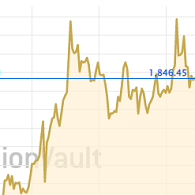
When we first wrote this in 2022, it took about $1800 to buy an ounce
of gold. Today, it is more like
$2900. That implies an $1800/$2900 = 0.621 or a 38% decline in Dollar value over that
period.
Prices will
eventually adjust, over a period of years, to the new, lower value of the currency, with some prices
moving faster and some moving
slower. "All things being equal" (they never are but it is a good principle), we should expect a
$2900/$1800 or 61% rise in prices of
goods and services going forward, compared even to the inflation-boosted prices that we have had to get
used to in
2022-2024.
Compared to prices in 2018, when it took about $1200 to buy an ounce
of gold, we should expect a
$2900/$1200 or 141% increase in nominal prices. Doesn't seem like much fun, does it.
This is why we say "you
can't devalue yourself to prosperity." No country ever got rich with a weak currency. They get rich with
a stable and reliable
currency, which means: a currency of unchanging stable value.
You would have to
increase your nominal income
by 141% just to break even. Maybe more than that, on an after-tax basis. Even if we do accomplish this,
eventually, what it would mean
is that we broke even, over a period of perhaps ten years. Instead of getting richer over ten years, we
just made it back to flat. In
other words, stagnation.
This is basically why the Latin American countries
never get anywhere. They are
always just catching up to the chronic depreciation of their currencies.
This
might be confusing to some
people, especially those with "Monetarist" leanings, and also those with "Keynesian" leanings – between
them encompassing 90%+ of all
formally-trained economists.
The "Monetarists" are concerned with "money
supply". They have a sort of
narrative which goes like this:
Expanding the money supply leads to more money
chasing fewer goods, leading
to rising prices. It is actually a pattern common throughout history, related to inflationary wartime
finance. But, that has not been
the common pattern since the Bretton Woods international gold standard era ended in 1971.
Instead, what we
tend to see is: A currency loses value, for whatever reason. Often, there is no particularly unusual
"expansion of the money supply"
going on, or any pressure from governments to somehow finance deficits with the printing press. It
doesn't fit the Monetarist
narrative at all – which is why they can't figure out what's going on.
Later,
as the economy reacts to this
decline in currency value, nominal prices and nominal GDP tend to climb. Central banks typically
"accommodate" this greater nominal
GDP with a proportional increase in base money supply.
During the 1970s, the
whole world suffered from
dramatic "inflation". The value of the Dollar fell from $35 per ounce during the 1960s, to around $350
per ounce during the 1980s and
1990s. It was a 10:1 or 90% decline in the value of the Dollar, compared to gold.
Commodity prices, and
prices for everything else too, verified that the decline in the Dollar vs. gold reflected a real
decline in Dollar value. Oil rose
from $3 a barrel in the 1960s to around $20 in the 1980s and 1990s.
But, there
was no particular "expansion
of the money supply" going on during that whole decade. It wasn't much different than the gold standard
era of the 1960s, or the
disinflationary "Great Moderation" of the 1980s and 1990s. Government deficits were relatively small,
and "printing press finance" was
nowhere to be seen.
During the 2000s, another major decline in the value of the
Dollar vs. gold took place.
From an average of about $350 per ounce during the 1990s, it fell to about $1200 in the 2012-2019 period
– roughly a 4:1 decline.
Commodity prices again soared higher, confirming that the Dollar's real value was indeed declining. A
barrel of oil went from an
average of about $20 in the 1990s to $60-$100 afterward.
But, during this
period, the base money supply grew
at its lowest rate of the previous fifty years!
I bring this up because we are
again seeing the same pattern.
The "inflation" of 2022-2024 was preceded by a gigantic increase in the base money supply of central
banks, as a response to the Covid
outbreak. This did amount to direct government financing, as governments ran gigantic deficits, issuing
bonds that were effectively
bought by central banks. It fit the Monetarist (or "Austrian") narrative well.
But today, we are seeing
another big decline in the Dollar's value vs. gold, with very little expansion – even some contraction –
in central bank base money
supply.
This will again confuse the Monetarists and Austrians (they are easily
confused), but we should
recognize that this is actually a common pattern, just as we saw in the 1970s and 2000s.
But, that's why we
had to write a book about Inflation.




 Email
us
Email
us