

Call That a Gold Forecast? Try THIS
First, assume a gold standard. Next...
I HAVE previously said that gold could reach $15,000 by 2026, says
Jim Rickards in The Daily
Reckoning.
Today, I'm
updating that forecast. Gold may actually exceed $27,000.
I don't say that to
get attention or to shock
people. It's not a guess; it's the result of rigorous analysis.
Of course,
there's no guarantee it'll happen.
But this forecast is based on the best available tools and models that have proved accurate in many
other contexts.
Here's how I reached that price level forecast.
This analysis
begins with a simple question:
What's the implied non-deflationary price of gold under a new gold standard?
No
central banker in the world
wants a gold standard. Why would they? Right now, they control the machinery of global currencies (also
called fiat
money).
They have no interest in a form of money they can't control. It took
about 60 years from 1914-1974 to
drive gold out of the monetary system. No central banker wants to let it back in.
Still, what if they have no
choice? What if confidence in command currencies collapses due to some combination of excessive money
creation, competition from
Bitcoin, extreme levels of Dollar debt, a new financial crisis, war or natural disaster?
In that case,
central bankers may return to gold not because they want to, but because they must in order to restore
order to the global monetary
system.
That scenario begs the question: What is the new Dollar price of gold
in a system in which Dollars
are freely exchangeable for gold at a fixed price?
If the Dollar price is too
high, investors will sell gold
for Dollars and spend freely. Central banks will have to increase the money supply to maintain
equilibrium. That's an inflationary
result.
If the Dollar price is too low, investors will line up to redeem
Dollars for gold and then hoard the
gold. Central banks will have to reduce the money supply to maintain equilibrium. That reduces velocity
and is
deflationary.
Something like the latter case happened in the UK in 1925 when it
returned to a gold standard
at an unrealistically low price. The result was that the UK entered the Great Depression several years
ahead of other developed
economies.
Something like the former case happened in the US in 1933, when FDR
devalued the Dollar against
gold. Citizens weren't allowed to own gold, so there was no mass redemption of gold. But other commodity
prices rose
sharply.
That was the point of the devaluation. Resulting inflation helped lift
the US out of deflation and
gave the economy a boost from 1933-1936 in the midst of the Great Depression. (The Fed caused another
severe recession in 1937-1938
with their customary incompetence.)
The policy goal obviously is to get the
price "just right" by maintaining
the proper equilibrium between gold and Dollars. The US is in an ideal position to do this by selling
gold from US Treasury reserves,
about 8,100 metric tonnes (261.5 million troy ounces), or buying gold in the open market using freshly
printed Fed money.
The goal would be to maintain the Dollar price of gold in a narrow range around the fixed
price.
What price is just right? This question is easy to answer, subject to a few assumptions.
US M1 money supply
is $17.9 trillion. I use M1 because it's a good proxy for everyday money. This is the supply that is the
most liquid and money that is
the easiest to turn into cash. It contains actual cash (bills and coins), bank reserves (what's actually
kept in the vaults) and
demand deposits (money in your checking account that can be turned into cash easily).
One needs to make an
assumption about the percentage of gold backing for the money supply needed to maintain confidence. I
assume 40% coverage with gold.
(This was the legal requirement for the Fed from 1913-1946. Later it was 25%, then zero
today).
Applying the
40% ratio to the $17.9 trillion money supply means that $7.2 trillion of gold is required.
Applying the $7.2
trillion valuation to 261.5 million troy ounces yields a gold price of $27,533 per ounce.
That's the implied
non-deflationary equilibrium price of gold in a new global gold standard. Of course, money supplies
fluctuate; lately they've been
going up sharply, especially in the US
There's room for debate about whether a
40% backing ratio is too high
or too low. Still, my assumptions are moderate based on monetary economics and history. A Dollar price
of gold of over $25,000 per
ounce in a new gold standard is not a stretch.
Obviously, you get around
$12,500 per ounce if you assume 20%
coverage. There are many variables in play.
This model is also straightforward.
It relies on factors we
learned about in our first week of Intro to Economics – supply and demand.
The
most significant development
on the supply side is the decrease of new mining output. As the chart shows below, mine production of
gold in the US has been
decreasing steadily since 2017.
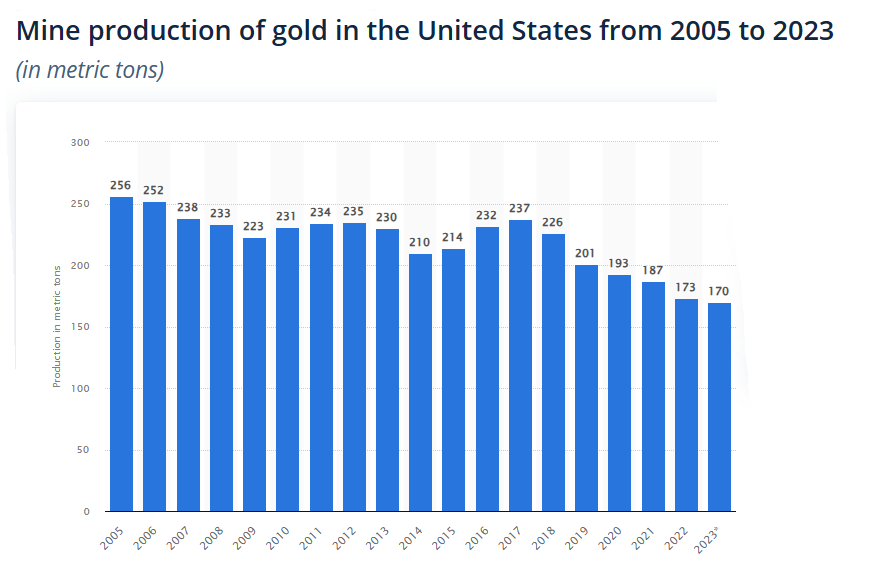
These figures reveal
a 28% decrease over seven
years, at the same time gold prices were rising and miners were motivated to expand output.
That's not to
argue that the world has reached "peak gold," (output could expand in future for a variety of reasons).
Still, my contacts in the
mining community consistently report that gold is becoming more difficult to source and the quality of
newly discovered ore is
low-to-medium at best.
Flat output, all things equal, tends to put a floor
under prices and to support higher
prices based on other factors.
The demand side is driven largely by central
banks, ETFs, hedge funds and
individual purchases. Traditional institutional investors are not large investors in gold. Much of the
demand from hedge funds is
conducted in derivatives such as gold futures.
Derivatives generally don't
involve physical delivery of gold.
They involve "paper gold" that far exceeds the actual, physical gold supply. It's this paper gold market
that accounts for volatility
in the gold market, not gold itself.
Meanwhile, central bank demand for gold
has surged from less than 100
tonnes in 2010 to 1,100 tonnes in 2022, a 1,000% increase in 12 years. Central bank gold demand remained
strong in 2023. There's no
sign of that demand slowing in 2024.
Overall, the picture is one of flat supply
and increasing demand, mostly
in the form of official purchases by central banks.
Finally, a bit of
elementary math is helpful in
understanding how the Dollar price of gold can move past $25,000 per ounce in the next two years. For
this purpose, we'll assume a
baseline price of $2,000 per ounce (although gold has been in the $2,300 range lately with no signs of
falling back to the $2,000
level).
But for our purposes, we'll keep it simple.
A
move from $2,000 per ounce to
$3,000 per ounce is a heavy lift. That's a 50% increase and could easily take a year or more. Beyond
that, a further increase from
$3,000 to $4,000 is a 33% increase: another large rally. A further gain from $4,000 per ounce to $5,000
per ounce is a further gain of
25%.
But notice the pattern. Each gain is $1,000 per ounce, but the percentage
increase drops from 50% to 33%
to 25%. That's because the starting point is higher while the $1,000 gain is constant. Each $1,000 jump
represents a smaller (and
easier) percentage gain than the one before.
This pattern continues. Moving
from $9,000 per ounce to $10,000
per ounce is only an 11% gain. Moving from $14,000 per ounce to $15,000 per ounce is only a 7% gain.
Gold can move 1% in a single
trading day, sometimes 2% or more.
As an extreme example, a move from $99,000
per ounce to $100,000 per ounce
is about a 1% move. Those $1,000 pops get even easier as we approach my calculated gold price of
$27,533.
The
lesson for you as an investor is to buy gold now.
As prices continue to rally,
you'll get more gold for your
money at the outset and high-percentage returns as gold rallies from a lower base. Toward the end of the
long march past $25,000 per
ounce, you'll have bigger Dollar gains because you started with more gold.
Others will jump on the bandwagon,
but you'll already have a comfortable seat.






 Email
us
Email
us