
Golden Nugget
So much smarter than the other gold bugs...
GOLD is misunderstood, but the misunderstanding extends to those critical
of others for
misunderstanding it, writes Gary Tanashian in his Notes from the Rabbit
Hole.
Because in Wonderland what is, it wouldn't be.
The subject of this post has
been made anonymous, as I've
decided to release it to a wider audience. Said subject anonymized those he was critical of and so,
turnabout is fair
play.
Elliott Wave technical analyst Mr.Anonymous (Mr.A) has an article
explaining his view of why gold is
misunderstood by analysts that claim it is a hedge against inflation and a hedge against stock market
weakness. On the surface, he is
correct. You cannot argue with facts and the facts are that gold has been a less than stellar inflation
hedge (under certain
inflationary circumstances) and it did go down significantly during Armageddon '08 and the 2020 pandemic
crash.
As noted more times than I care to remember, there are far better hedges against inflation
than gold when the inflation
manufactured by policymakers is working, albeit temporarily, in support of the economy. Mr.A is also
correct in noting that gold went
down in the market crash of 2008 and the lesser crash in 2020.
So what is my
beef here?
Well, we have yet another analyst discussing gold as if it were simply an asset among other
assets, focusing on its
nominal performance rather than its long-term value and importantly, its relative value when marked up
or marked down, as the
anti-bubble to most other asset markets, which have been sustained for decades now by a bubble in
aggressive and inflationary
policy-making.
It is a bubble that I believe has ended, although it doesn't
consciously know it yet, with
policy-propped asset markets now little more dead men walking. That assertion is based on several macro
indicators I use, but none are
more visually striking than the decades long trend break in the 30-year Treasury yield
Continuum.
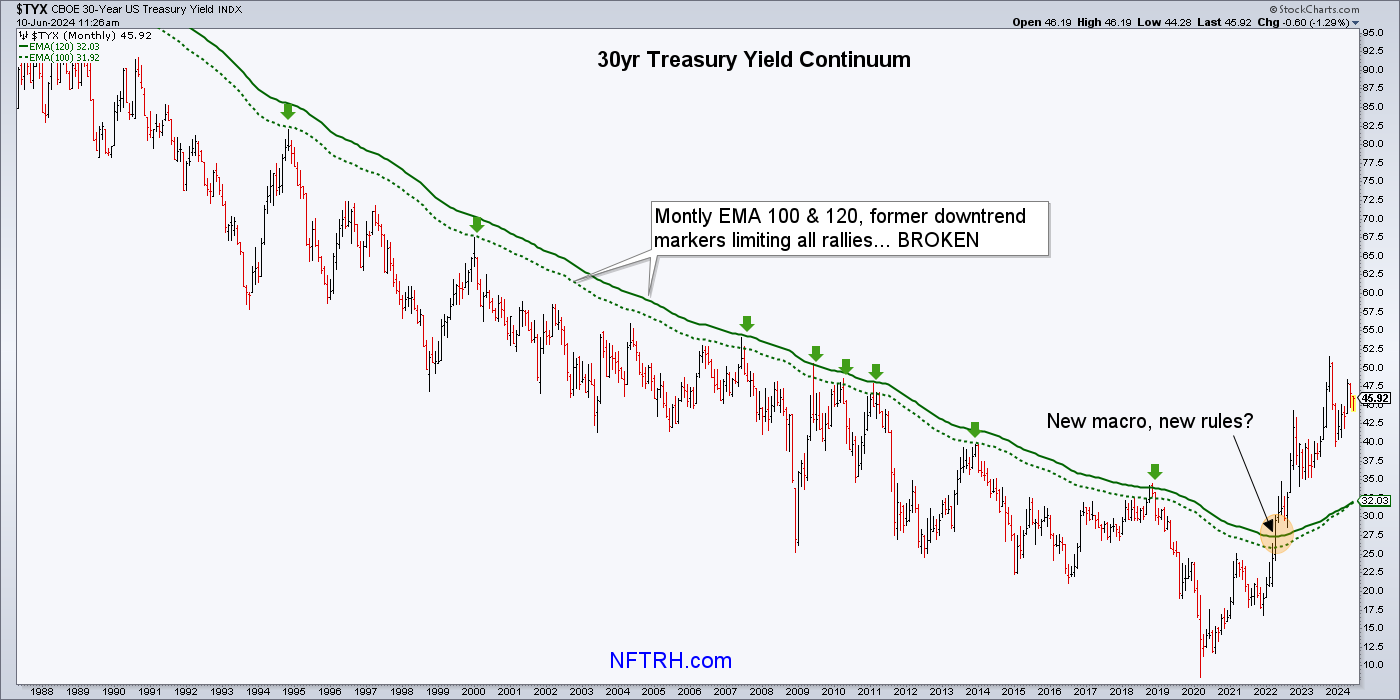
Among other things,
that trend
break implies that the ease with which policymakers were able to inflate the system at every crisis or
even hint of crisis is a thing
of the past.
The sedate bond market signaling gentle disinflation gave license
to inflationary policy at
every sharp downward turn of the Continuum. That ease and simplicity is history now, and hence the odds
have increased that the bubble
is done (although still stumbling forward trying to make its way to or through the US presidential
election with several fiscal
initiatives beyond the scope of this article in play).
But here is the key
point: Gold is the anti-bubble.
Its positive correlation with bubble beneficiary markets since it ended its post-2020 corrective phase
in Q4 2022 is one of two
things: cause for concern about the nominal gold price when stock markets take the next bear, or the
beginning of the new macro as
gold looks ahead to the obvious end of the policy-induced bubble. When stock markets take the bear, I
would not bet on gold merrily
going up.
So there again, on the surface Mr.A is correct. However, it sure as
shootin' will
outperform.
Let's take a few quotes and rebut, shall we?
"I do not have to go
back terribly far in history to prove this premise as being an outright falsehood. First, let's start
with early 2020. As the SPX
proceeded to crash during the Covid outbreak, did gold rally? Nope. Did gold at least remain stagnant?
Nope. In fact, gold proceeded
to drop by 15% during that time. Silver was even worse as it lost almost 40% of its value during that
same
timeframe."
Gold is not supposed to rally in nominal terms during
crises. It is supposed to retain
relative value. This is what gold did in relative terms to SPX during that crisis.
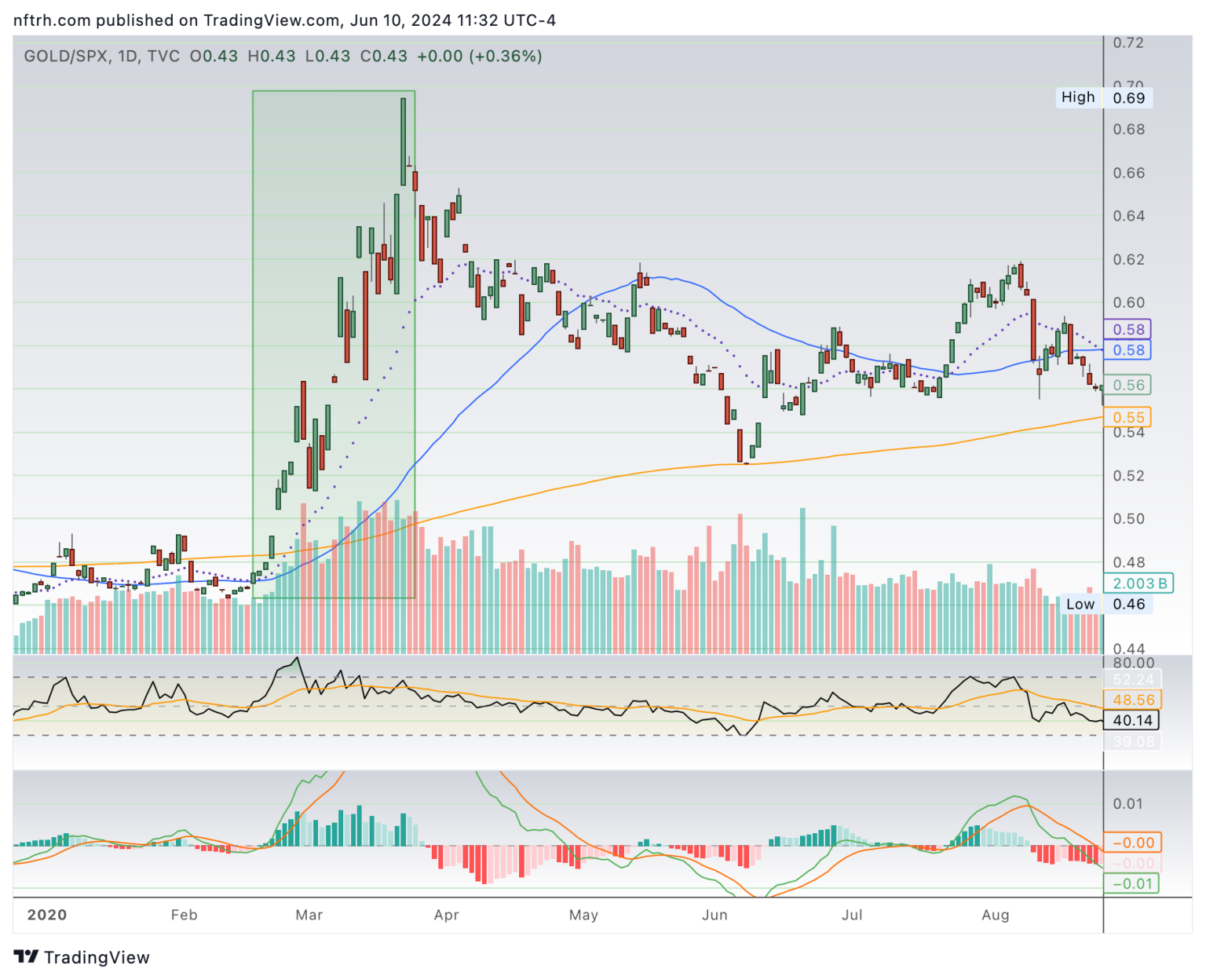
After its
relatively moderate nominal decline, gold led most markets out of the abyss before the inflationary
bailout operations of central
banks and governments set it up for a long correction as cyclical markets regained footing. That was as
it should be for the
anti-bubble.
As for silver, it is not gold. I don't know why it is even
included in this conversation. Silver
is even further from an effective disaster hedge than gold, as it has more cyclical industrial qualities
than gold (although it can be
a better inflation hedge).
Now, if you are still not convinced, well, let's go
back a bit further to the
Great Financial Crisis of 2008. Again, did gold rally during this financial upheaval during which the
perceived "safety" of gold was
sorely needed? Nope. Did gold at least remain stagnant? Nope. Gold lost 30% of its value, which clearly
outlined that you cannot rely
upon gold as a hedge against stock market upheaval.
And, again, silver was much
worse as it lost 60% of its
value during this time.
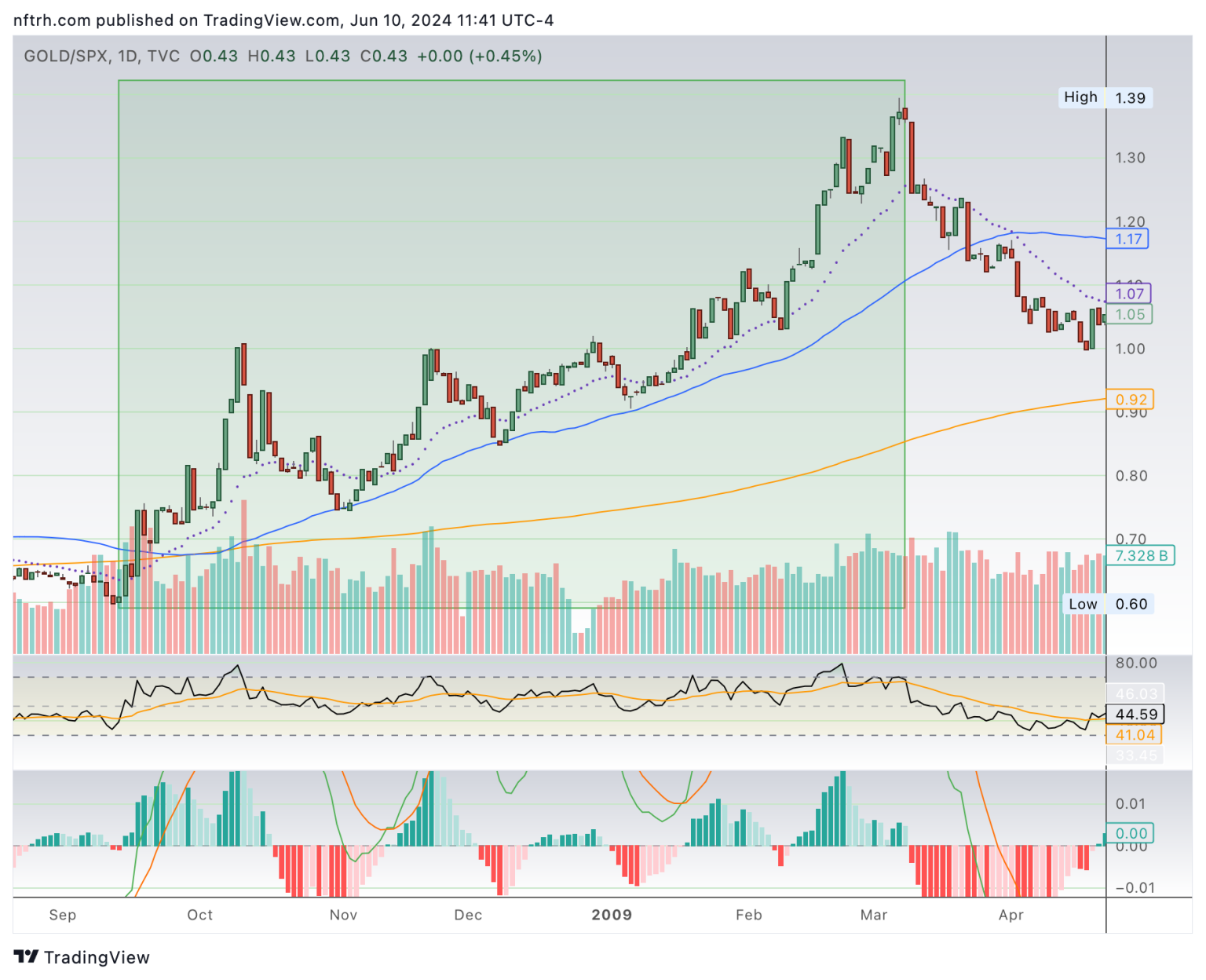
Gold got
hammered during Armageddon '08
(which for stocks, actually extended to Q1 2009) but in relative terms it rose strongly vs. SPX and
rocketed higher vs. cyclical
commodities like oil and base metals. It then went on to out and under perform periodically as cyclical
inflation manifested out of
the 2008 policy panic and subsequent years of Zero Interest Rate Policy (the financial blight known as
ZIRP).
But, clearly, history did not teach this lesson to everyone, as many completely ignored what occurred
during this timeframe, and again
expected gold to save them during the Covid crisis. And the many that have still not learned this lesson
now come back to
prognosticate that gold will provide safety in the event the stock market turns down.
What is most
interesting is that most of these same folks also maintain a world view that gold will not rally
alongside the equity market. In fact,
I just read another article which outlined this erroneous commonly held view, and claim surprise when it
does rally alongside the
equity market.
The point with gold is its relative performance. Nominally, it
is going to go up or down as
the prevailing winds and varied macro inputs (economic, policy both monetary and fiscal,
inflation/deflation, disinflation,
psychological/sentiment, etc) dictate. But the big picture macro is what is important.
Where has it been?
Where is it going? What is it indicating?
As for the "surprise" of gold being
correlated with asset markets
lately, it is already noted above that gold is either being set up for price pressure when a broad bear
market ensues or it is
diverging to indicate the new macro.
Mr.A goes on to discuss what I have harped
upon for many years, that
gold is not usually an effective inflation hedge, at least during the pro-cyclical previous several
decades. Let's not dig that up
again. Anyone who bothered to look beyond the standard gold bug dogma already knows that. Let's however,
rebut one final
point.
"My friends, at some point, one has to open their eyes and look at
markets objectively. Gold is not
driven by inflation. Nor is it driven by deflation. Nor is it driven by the Dollar. Nor does it fall
when the equity market rallies or
vice versa. Gold is driven by market sentiment. And it is the only constant in the gold market which
allows one to maintain an
objective perspective on the price trend in gold, and be able to prognosticate that trend in any
reliable and consistent
manner."
Gold's case should not be simplified to only sentiment unless we are
discussing the very big macro
picture. While sentiment is an important tool in managing an inherently emotional sector like the
precious metals, it is far from the
only consideration.
Mr.A is writing in linear fashion, as if the decades of the
Continuum's downtrend were
still intact. The gold market going forward will respond to policy initiatives and constraints, economic
acceleration or more likely
in the few years ahead, deceleration. Gold market sentiment is a knock-on effect of what is already
happening. That is what sentiment
is, a tail chasing the dog. The dog being macro fundamentals and technicals.
Notice I did not mention war,
pestilence (the hard post-pandemic correction for gold was in the bag by mid-2020 due to damaging hype),
China/India buying or any of
the other common themes put forth as fundamentals for gold. Boiling it down, gold is about policy and
sentiment. Aside from being a
very long-term holder of real monetary value, gold is a barometer of mass confidence or lack thereof in
policymakers in government and
finance trying to regulate the economy and associated markets to desired and by definition, manipulated
ends.
So yes, gold is about sentiment. But it is about big-picture sentiment on a societal level. That is why
a significant change in the
long-term macro is so important. It is going to feed sentiment on a mass scale in the years ahead. My
rebuttal seeks to add layers and
detail to another analyst's opinion, rather than express outright criticism.






 Email
us
Email
us