
Prepping Gold for the 'Post-Bubble'
Stocks keep soaring, miners keep hurting...
The BUBBLE in 'no holds barred' monetary policy (birthed under Alan
Greenspan) and the bullish markets
it benefits are in their third decade, writes Gary Tanashian in his Notes from the Rabbit
Hole.
Gold, meanwhile, will not be ready until the "post" bubble.
This is an article
from a source, yours truly,
who considers it his job to define the 'top down' macro before trying to pick stocks. In other words, it
is important to get the big
picture macro, as well as its shorter-term rotations, right before trying to select stocks and the
sectors they reside in.
In an extreme example, the gold mining sector has been most often impaired by the 'bubble
on' macro, including its
inflationary phases, not helped by it. "Post-bubble" will be a different story. But you can't change the
macro because of 'want'. It
will change when it is good and ready.
In the year 2001 Sir Alan Greenspan was
forced to abandon his stately
"Maestro" image in favor of a more desperate, even panicky version of himself. That desperation was put
into effect by the various
inflationary means used to birth and blow the credit bubble, which launched the real estate/mortgage
bubble and eventually, the great
stock market bull that persists to this day.
This is ancient history
(2003-2008), but it was an important
time when we as market participants were taken down the rabbit hole, whether we liked it or not.
Fittingly, the end of this historical
phase resolved in a righteous market liquidation of Q4 2008.
By then it was Ben
'the Hero' Bernanke's turn to
try his hand at inflationary bubble making, and inflationary bubble-make he sure did. New and unusual
methods of QE/Bond
Manipulation/ZIRP and a new twist on things in order to "sanitize" (the actual word the Fed used back
then) inflation signals out of
the macro, aptly named Operation Twist.
You think this was anything remotely
resembling normal? This 'twist'
not surprisingly came after the Bernanke Fed had cooked up inflationary operations of its own that were
threatening to point a finger
right at these big brained monetary/economic intellectuals that were primary in creating every inflation
problem since
2001.
Inflation begins with money printing by various means. The pure
definition is inflation of money
supplies chasing finite assets. Inflation was turned on like a spigot whenever our remote-controlling
monetary managers wished. Later,
in its effects, come the cost-push inflationary problems like those of the recent cycle.
The Federal Reserve
actually saw the potential for its previous inflationary episodes to get out of hand (Greenspan era into
the Bernanke era) and
concocted a bond market manipulation scheme to paint inflation right out of the picture. And guess what?
The market bought it. Market
players bought it. Lapped it up like dogs. They kicked the 10yr-2yr yield curve into a flattening phase
and Goldilocks flavored
economic boom. That was generally the 2013 to 2019 era generally attended by a strong US
Dollar.
To this day,
the dogs devour every morsel thrown their way and their confidence in our monetary regulators is intact,
by definition. Every time a
still hot economic or inflation signal comes in the market quakes in its boots, and that includes the
anti-bubble, gold. Confidence =
intact. Gold is for when "intact" becomes "unglued".
Hence, the only thing a
right-minded market participant
can do (excluding the vast majority who still think it's normal as their financial advisers continue to
cost average up into nosebleed
territory) is not short it in committed fashion, play it from the long side with risk management, or sit
and collect the cash income
that the Fed is paying you to take advantage of.
As for speculating from the
long side, what has been working
best over the last year is what we originally projected a year ago: the Goldilocks stuff.
A market in full
submission to the Fed's every utterance from its various orifices continues to view 'cost-push'
inflation implied in the January
Payrolls report and even a slight uptick in Manufacturing (we'll take a brief look at the latest ISM in
this weekend's NFTRH report)
with fear of the Fed, which in turn has been driving the US Dollar.
So
confidence is intact, by definition.
Markets are flat out bullish. AI is going to make us all rich (well, I sold SMCI too soon, collecting
only a 70% profit on two
separate trades. Actually, I had to sell SMCI just as I had to sell ANET before it because my DNA
directs me not to be a hype follower
and by extension, anything resembling a committed bubble player.)
This graph
produced by John Hussman was
taken from a more extensive article, which you may want to check out. Feel free to reference the NFTRH
Links page any time, as you'll
find Doc Hussman and many other worthwhile sources there (market tools, economic data, industry
news/analysis, biased and unbiased
analysis alike, and so much more). I've built that links page for my own reference. Why not bookmark it
for yourself?
Here Hussman illustrates in one picture that our bullish markets and strong economy are the
products of leverage. In an
ongoing bubble this does not matter. In a bursting bubble? Well, it matters.
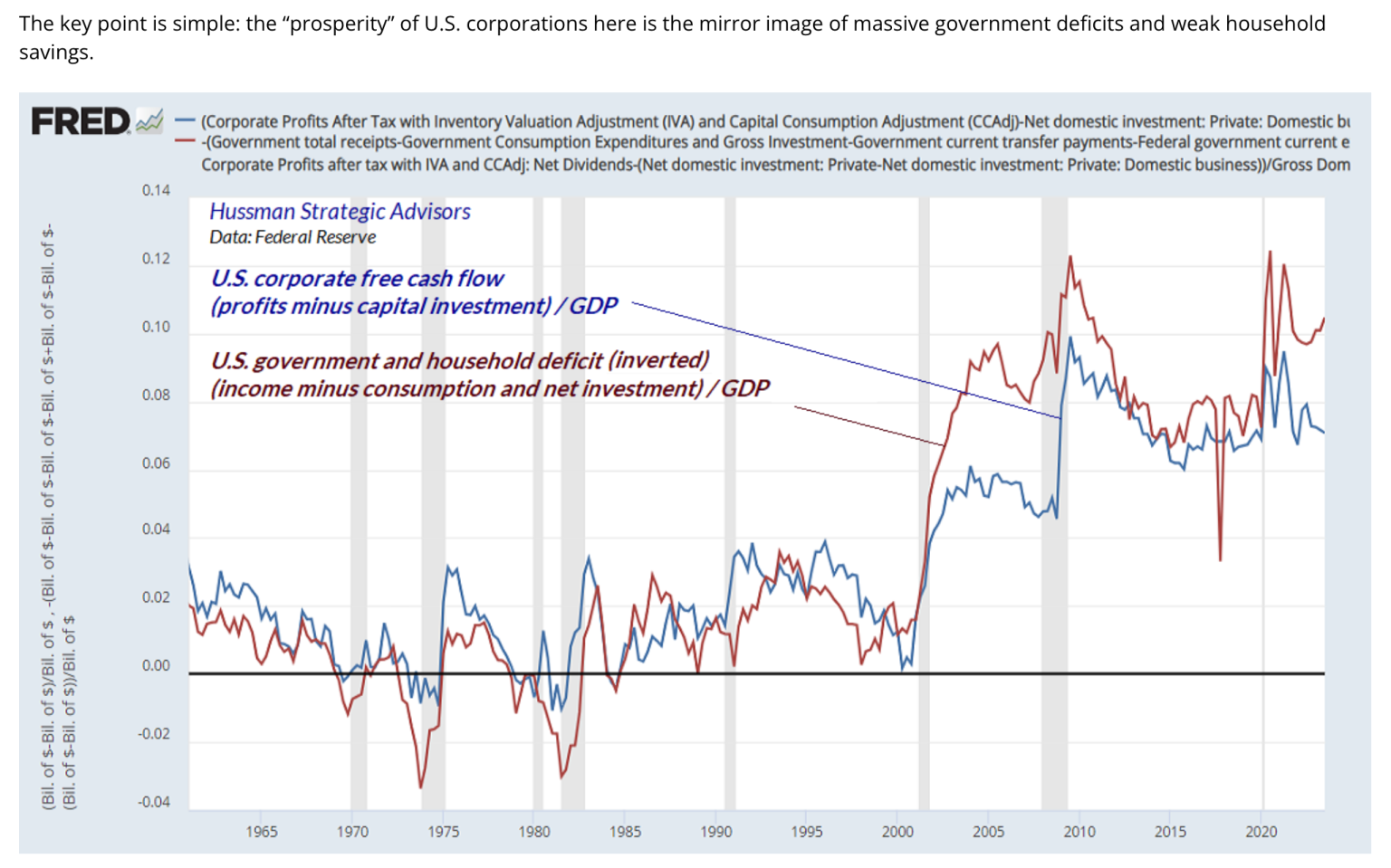
So the above is a bullish
picture at high risk because it is the product of leverage to a growing debt pile and by extension,
deficits. That is what the economy
and associated bull market are built upon.
Play it if you will, but also
understand it for what it is. For
those submitting to the Fed's every utterance (not to mention to their mainstream financial advisers'
assurances that they are
professionally managing their wealth in the ways of tradition) it's all good...as long as the bubble in
policy and associated markets
and thus, confidence are intact.
Other indicators we use in NFTRH show what we
have been noting for months;
that the market is two things: 1) bullish and 2) at high risk. To save room for more pointed discussion
about individual equities and
strategy in the upcoming NFTRH 796, I'll drop a cavalcade of our indicators in this public article for
subscribers and the public
alike to review.
Again, I want to remind you that the Goldilocks story above is
from a year ago when nobody
else was talking "Goldilocks" and a relative few were talking bullish in general. I point that out
because when I write highly
negative articles like I perceive this one to be, proven credibility (that I've not been a perma-bear,
perma-bug or perma anything
else to this point) is important. I simply have to write about what I see and I don't care whose agenda
it may or may not
serve.
On that note, risk is play in the form of sentiment and in the form of
other indicators like the
extreme low in the defensive Healthcare sector to the broad SPX. The XLV/SPY ratio has historically and
reliably spiked upward into
and during bear markets and hard corrections. The exception was 2012 to 2016, when there was a lot of
Healthcare-related political
noise in the picture. The ratio shows high risk to equities and yet a still bullish
situation.
Speaking of a
still bullish situation, the Semiconductor > Tech > Broad leadership chain has been a staple in
NFTRH, keeping us from
attempting an active bearish orientation and/or keeping us with a bullish view (risk and all). SOX
leading NDX and NDX leading SPX is
the bullish leadership recipe. It's intact, if not yet fully baked.
As for
gold, it is not yet signaling
either a bear market or an illegitimate bull market for stocks.
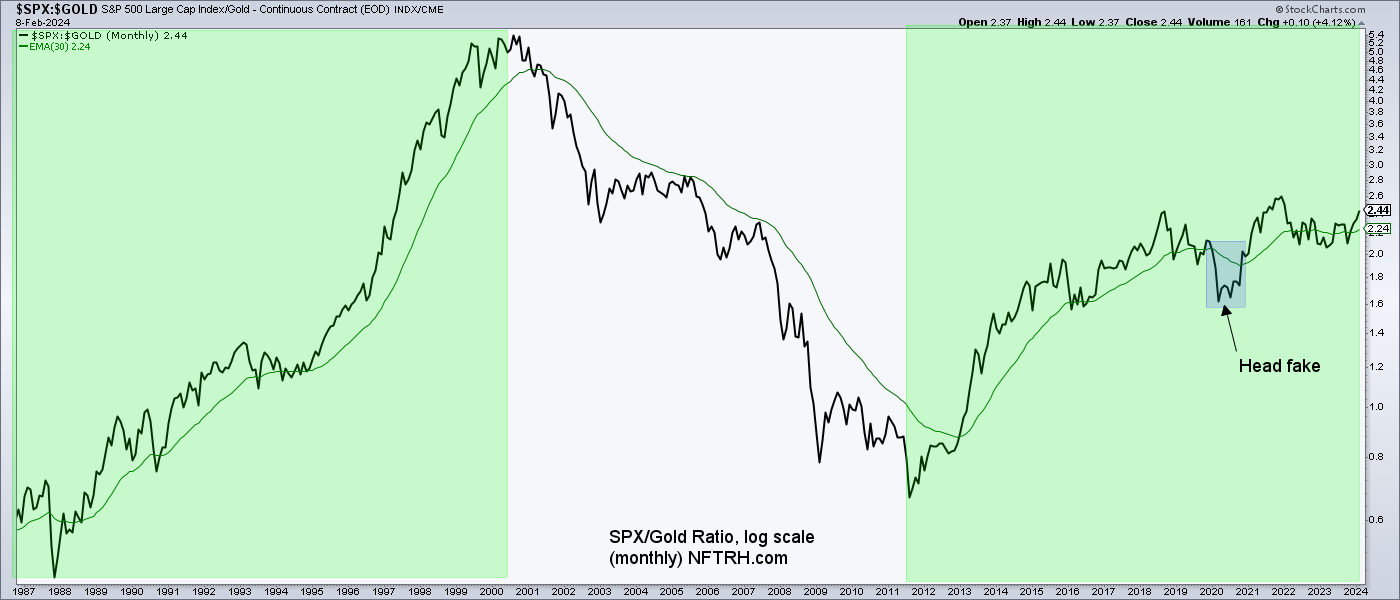
During the un-shaded period from 2002 to 2011
the stock market spent the majority of the time in an apparent bull market. Stocks were going up! Gold
went up better. Currently,
SPX/Gold shows stock bulls sleeping soundly.
However, the Copper/Gold ratio
shows that aside from the 'strong
Dollar'/Goldilocks stuff, a down economic cycle and stock market bear are just itching to come into
play. Post-election, perhaps? Can
they hold it together that long? NFTRH 795 put on its tin foil hat recently and took a hard look at that
question, both pro and
con.

Meanwhile,
another risk indicator to a still
bullish market situation is the current state of the VIX vs. the bulling SPX. It's not a major thing,
visually. But historically the
VIX has tended to travel at least flat with a positive bias prior to SPX corrections. Today? Well, VIX
is traveling with a positive
bias in defiance of the big bull move in SPX.
We anticipated, if not predicted
a bull move in SPX, after all.
The anticipation was for anything from a slight higher high double top to an upside 'suck 'em in' FOMO
extravaganza and upside blow
off. The market is agitating for the latter now.
Ironically, the recent bump up
in Fed hawkishness could
sustain the bull run in stocks longer than if they had remained stapled to the March rate cut view. It's
when the Fed is finally
compelled to start cutting to get in line with the declining 2yr yield that max bear damage has been
inflicted. I don't say so. The
chart and history say so.
There are many more indicators we use. From Libor
Yields to High Yield Spreads to
Yield Curves and more that are currently telling us the...
Bottom Line (as per
NFTRH for much of the last
year):
The stock market – especially in its headline areas – is bullish
and...
The stock market
is at high risk.
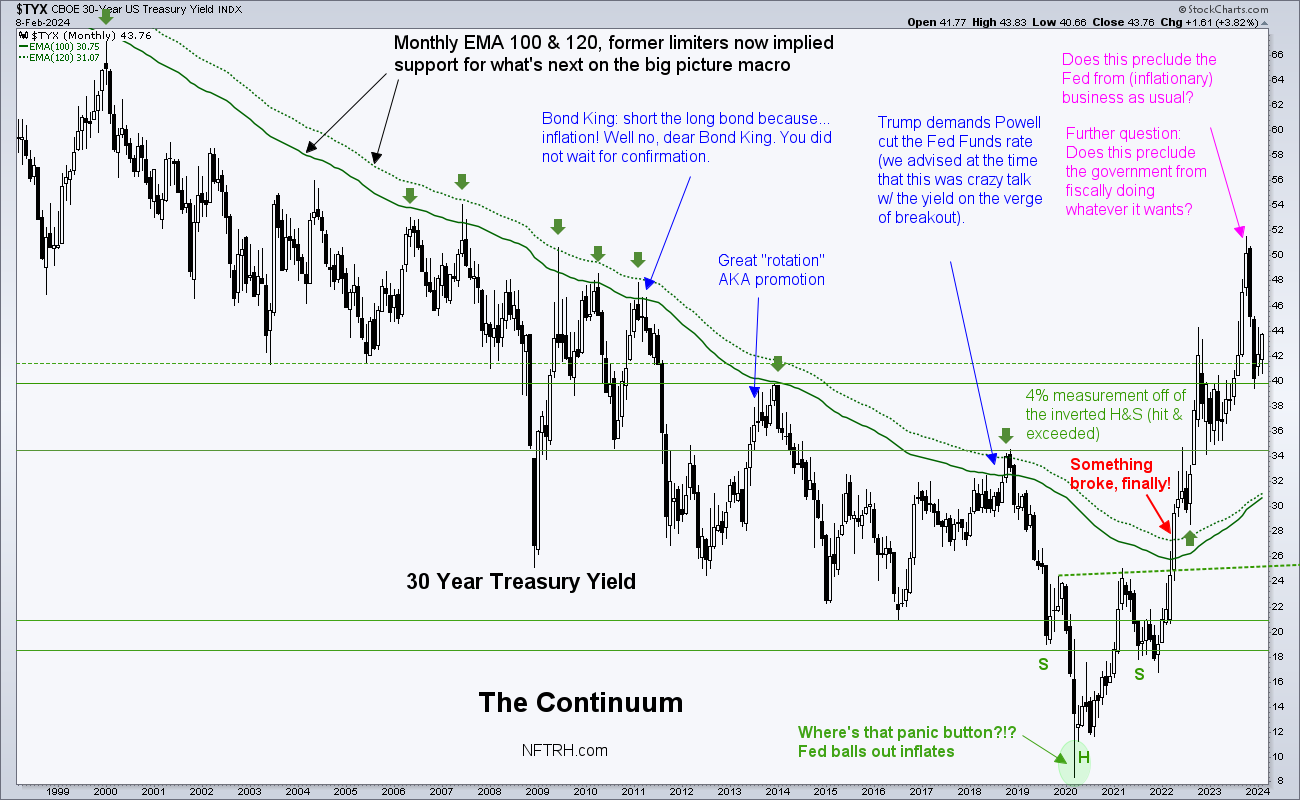
Gold, not mentioned much in this article, nonetheless lays in
wait for the post-bubble. I'll
continue to respect the idea that a major post-bubble indicator kicked in in 2022. That would be in the
in the form of the king of
NFTRH indicators, the 30-year bond yield Continuum, which after years of keeping us aware that
inflationary policymakers were in full
control (the Continuum indicated pleasant disinflation, after all) smashed its limiting moving
averages.
And
you wonder why today's Fed is so zealous about fighting inflation?
"Post-bubble" will be the only macro that will
sustain an extended and potentially epic move in the gold mining industry. Because by then, the gold
mining product's relationship to
cyclical and risk 'on' asset markets will leverage the miners' bottom lines to the upside.
This is the Bob
Hoye playbook, but it's been elusive over the bubble years (decades) and it's still not quite time yet.







 Email
us
Email
us