

Banking Crash? Fed Just Raised Rates Above Entire Treasury Yield Curve
Recession now racing this way says US bond market...
I'M NO FAN of 19th Century doorstoppers running to hundreds of pages with
a cast of
thousands, writes Adrian Ash at BullionVault in this note first shared with readers of the Weekly Update email on
Monday.
But
even if you've never read Anna Karenina, you probably know the opening line, if not the sad
ending:
"Happy families are all alike; every unhappy family is unhappy in its own way."
Now, being a financial pundit
in need of an opening line today, I wanted to spin this for the banking sector here in spring
2023.
But
writers on deadline rarely stumble across unique ideas, and someone smarter than me just cut to the
chase...
...asking Microsoft's ChatGPT for
help:
"All well-run banks are alike; each poorly run bank is poorly run in its own
way."
I, for one,
welcome our new robot overlords. So let's go with that.
Just how poorly-run
were the banks to fail so far or
face collapse in this 2023 scare?

Roughly
speaking, a bank takes in deposits while making loans.
To turn a profit, it
just needs to pay less interest
on the deposits than it charges on the loans.
Simple, right? Apparently
not.
Silicon Valley Bank
Took in too much cash from too many tech start-ups who
were flush with money and
didn't need any loans.
So to generate income, SVB bought long-dated bonds,
mostly US government debt. Those
Treasury bonds are the safest thing in the financial world...up
until they sank in
price as inflation jumped and the Federal Reserve hiked interest rates at the fastest pace in pretty
much ever.
Net result? SVB's loans (to the government) weren't worth what its depositors were owed.
Cue a run for the exits when "a
small number" of venture capitalists took to WhatsApp and shouted
'Fire!'.
Signature Bank
Lent money on New
York real estate (among other
things) while taking in lots of cash from crypto firms, even building them a payments platform (called
Signet) so that the crypto firms' customers could turn magic beans into real Dollars
24/7.
Like SVB,
that 'concentration risk' of too many customers all in the same business all at the same time meant that
its depositors all started
needing their money back when interest rates rose and crushed crypto. Lots of its borrowers suddenly
started looking flaky for the
very same reason.
Cue a rush for the exits, again led by bigger depositors
spotting that they might need but
hadn't got a government guarantee. Because, to quote Investopedia, "Signet
required a minimum account
balance of $250,000; FDIC insurance caps out at $250,000."
First
Republic
Had a
lot of deposits bigger than the US insurance limit, again making it vulnerable to a rush for the exits
if people started to worry. It
then parked a lot of those deposits in long-term bonds, suffering a steep loss of value as bond prices
sank so that yields could rise
alongside short-term interest rates.
Cue a rush for the exits because, well,
just because. FRC's financial
results for 2022, released in mid-January, actually looked pretty strong at first glance...
..."another terrific
year of safe, consistent and
organic growth" according to its CEO.
But with over 2/3rds of the money it held
on deposit uninsured by the
FDIC guarantee, that cash
still ran for the door, and the share price slumped, as the banking scare took hold and
spread.
No, it doesn'y help that news of massive
salaries for the founder, his brother-in-law and his son is now coming out. And it really
doesn't help that the $30bn
which 11 major US institutions put on deposit at FRC as a (government-driven) show
of
confidence did nothing to stem the share price slump last week.
Credit
Suisse
Very much bigger than the first two US casualties or crisis-hit FRC above,
so it's harder to summarise.
But in short, CS was just very badly run...flailing its way through any number of scandals, swapping its
CEO, announcing a whole new
plan, spooking its investors, and managing to make a
monster loss in 2022 of
more than $7 billion, pretty much equal to what its Swiss rival (and now owner) UBS made
in profit.
Scandals weren't
new at
CS however, and it was far from alone in scandalous banking. But a rush for the exits started last
autumn, with depositors pulling out
$120bn in Oct-Dec alone. The coup de grace then came 2 weeks ago, when the boss of the bank's biggest
investor...Saudi Arabia's
state-owned Saudi National Bank...said "No,
absolutely
not" when asked if he would stump up any more cash to keep it in business. (He has since
'resigned' for 'personal
reasons'.)
Contra Count Tolstoy then, a couple of common points stand out at
these unhappy banks.
First, concentration risk: Is your bank serving all the same type of
customers, whether on its loans or
deposits? Just as importantly, how much of the deposits aren't covered by insurance? Big money runs
fastest.
Second, regulatory pushback or failings: Credit Suisse kept blotting its copybook,
while both Silicon Valley and
Signature wanted to avoid the hassle and costs involved in the rules and oversight of becoming a very
big bank worth more than $50
billion...a level set by the post-financial crisis Dodd-Frank Act. But rather than capping their size,
they lobbied to get the
threshold raised! The Trump administration obliged
in
2018, raising the minimum level for "enhanced oversight" to $250bn.
Third, don't simply
trust in longevity or brand. Credit Suisse was founded in 1856 and became synonymous with the
stability, security and
safety of the mountain-ringed nation. SVB had been around for almost 40 years, growing to become the
16th largest bank in the US by
this New Year (but repeatedly telling lawmakers that it wasn't all that big really, and not
big enough to
warrant a big-bank regulation).
First Republic has been around since 1985, and
while Signature had a
more chequered history, it had grown since
launch in 2001 to the 19th largest US bank, even bagging former Republican Barney Frank as a member of
its board of
directors.
(Yes, THAT Barney Frank, one half of the post-financial crisis'
Dodd-Frank Act, which claimed to
make US banks much safer by fighting the last war. He's now
mad
as hell that the feds shut down his bank and sold off its assets...well, those assets that anyone
might want to buy...just
because it threatened to spark a sector-wide panic.)
Okay, so that's the scare
so far. What comes
next?

"To be crystal clear...Deutsche is NOT the next Credit Suisse."
So
said a research note picked
up by pretty much every financial
journalist late last week as shares in Germany's No.1 bank fell and fell again.
And in contrast to the
flakier little banks above, Deutsche says that 76% of its
German retail deposits are covered by the Eurozone and German government insurance schemes, with 1/3rd
of its total deposits covered
worldwide.
Moreover, as the Wall Street Journal says, "The bank is solidly profitable,
has the strongest capital
ratios since the late 1990s, and has lower interest-rate risk than some US regional banks.
"[So while]
Deutsche Bank itself is also no stranger to tough times, it is far more advanced in its turnaround than
Credit Suisse was when
confidence evaporated."
For now the gold market seems to agree, easing back
rapidly from last week's
banking-scare peaks as the depositors' rush for the exits takes a breather and European and US banking
shares rally.
Maybe this pause in fact marks the end, and the 2023 banking crisis will have lasted for
just a few weeks in March. But
some people said that about Bear Stearns 15 years ago, and even among the compliant, well-diversified
and well-capitalized banks
today, the real trouble hasn't yet hit.
Because the loan-book hasn't yet turned
sour.
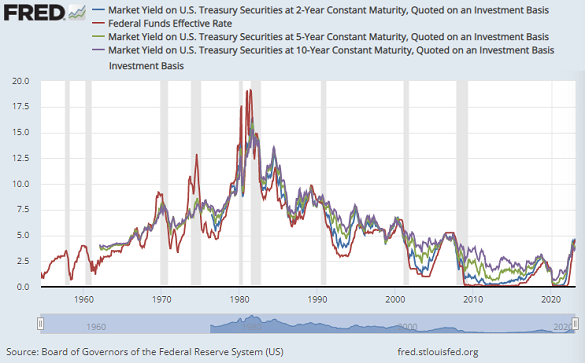
Squint hard enough at this chart and you can
see how...every time a US
economic recession is about to begin (as marked by the vertical dark grey bars)...the red line has risen
above all the
others.
That red line marks the US Fed's key interest rate, the Fed Funds rate.
The other lines mark the
annual yields offered to new buyers of 2-year, 5-year and 10-year US government bonds.
We could add the rate
offered by 30-year or 12-month, 6-month or 3-month bills, too. It wouldn't matter. Those rates
also went below the Fed's target interest rate just before a US recession
began.
And for reference, following last week's action...
...when the Fed Funds rate
was raised to a ceiling of 5.00% while the banking scare sent US bond yields sharply lower yet
again...
...the Fed's key interest rate is now higher than the yield on any US Treasury bond or bill once
again.
This
kind of picture, where short-term rates come above longer-term rates, is known as an 'inverted yield
curve'. Inverted because, more
normally, long-term lenders get a bit more in annual interest than short-term lenders, to compensate for
the extra time risk. And the
gap between 10-year and 2-year US bond yields has now been inverted non-stop for 9 months, shouting
"Recession!" at passers-by because
it suggests that, sometime in the future, US interest rates will need to fall.
The track record of the 10-2
measure isn't perfect, however. It's called recession a little more often that a US recession has
actually followed. But it's now
half-a-year since the 10-year minus 3-month yield curve also flipped negative, and now that the Fed's
overnight rate stands above
every yield you can get from a US Treasury bond, note or bill, the market is screaming "Recession!" like
no time since, well, the eve
of the last economic downturn.
Whatever the mechanism or process by which an inverted yield curve turns into an
economic downturn, this
feature...where the Fed raises its interest rate above anything offered in the Treasury debt
market...has preceded each of the last 8
recessions in the world's largest economy, including (weirdly) even
the Covid Crash of 2020.
It's just happened again. And some poorly-run banks
were already in
trouble.

"There's something wrong! The bank won't
give someone their money," says a
lady queuing at the bank in Mary Poppins, half-hearing a commotion about tuppence belonging to
a child.
"Well I'm going to get mine!" says the lady next to her. And so begins the near-collapse of
the Fidelity Fiduciary
Bank.
It all sounded quaint and Victorian back in 2007 when Northern Rock failed, and it seemed
absurd when
Bear Stearns went in March 2008, nine
months after it made the headlines over the pile of toxic debt
derivatives it held. But in the week ending Wednesday 15 March 2023, depositors at smaller US
banks pulled out a record $107bn from their
accounts...
...almost what global giant Credit Suisse lost in the last 3 months of 2022 combined.
In the final analysis,
a banking run means that depositors...right or wrong...fear that the bank's debtors aren't going to
repay their loans, leaving the
bank without enough cash to repay its savers.
This bad genie is now freed from
his bottle once more. Loans
across Western banking markets haven't yet started to
sour. But the bond market says a US recession is racing towards us.
Y'know,
like a steam train.







 Email
us
Email
us